




Mapping and route planning with LiDAR
LiDAR-based scanning identifies walls and columns, and the robot maps its surroundings and autonomously follows the planned route; positioning accuracy of ±5 cm enables repeatable grinding.
INDUSTRIAL & LOGISTICS ROBOTS · BMR
Autonomous planetary-disc concrete floor grinding and preparation robot
The BMR Floor Grinding Robot prepares the substrate before coating by removing the cement laitance layer from concrete surfaces with a planetary disc. It is available in two versions: the dust-extraction 850M and the non-extraction 850S; it features fully automatic navigation and data management.
SELECT BY TASK
The BMR Floor Grinding Robot is an autonomous construction machine developed in two versions for preparing concrete floors before coating: the dust-extraction 850M and the non-extraction 850S. Both models perform fully automatic, repeatable grinding with a high-performance planetary-disc grinding motor, LiDAR-based environmental sensing, and intelligent route planning. The robots operate with real-time positioning and autonomous navigation; automatic stopping, disc protection, and operating data statistics are standard. The 850M model has an integrated automatic dust extraction system, while the 850S offers a more compact design. One operator can manage one or more robots, reducing the need for manual labor; multi-machine coordination provides a uniform surface over extended periods of uninterrupted operation. They are used in projects where pre-coating preparation is important, such as underground parking garages, factories, laboratories, and sports facilities.
PRODUCT-SPECIFIC
Features compiled from source product information; evaluate according to the model and configuration.
LiDAR-based scanning identifies walls and columns, and the robot maps its surroundings and autonomously follows the planned route; positioning accuracy of ±5 cm enables repeatable grinding.
The 850M model features integrated automatic dust extraction, while the 850S is non-extraction and more compact; the suitable model can be selected according to the application site.
Fully automatic operation and coordination of multiple robots enable extended periods of uninterrupted grinding; compared with manual grinding, this delivers greater continuity and efficiency.
Pre-planned routes keep grinding depth and coverage consistent, reducing the risk of over- or under-grinding between areas.
Safe stopping when encountering obstacles, disc protection mechanisms, and fault alerts are provided as standard, supporting safe and controlled operation.
Operating time, area, and status data are recorded through FMS cloud data management; these data can be used to monitor operations and generate reports.
A guided cable payout and one-touch cable retraction mechanism simplify cable management and maintenance work on the construction site.
The planetary disc design and high speed range enable effective removal of the cement laitance layer from concrete surfaces.
SOURCED PRODUCT DATA
Values are taken from the source product page. Confirm the package, software, and accessory contents against the manufacturer's current documentation before ordering.
| Feature | Value |
|---|---|
| Dimensions (standing) | 850M 2030 × 915 × 1275 mm; 850S 1520 × 866 × 1204 mm |
| Weight | 754 kg (850M) / 627 kg (850S) |
| Operating capacity | Working width 850 ± 50 mm; planetary disk 400-2000 (850M) / 0-2000 rpm (850S); grinding power 18,5 kW; dust extraction 2,4 kW (850M); positioning 5 cm |
| Maximum speed | 0,5 m/s |
| Climbing angle | 15° |
| Positioning accuracy | 5 cm |
| Working width | 850 ± 50 mm |
| Battery | Grinding: three-phase, five-wire 380 V AC, 50/60 Hz; travel: 48 V 30 Ah battery |
| Range | 9 km |
| Manufacturer's note | Safety and automation: safe stop when an obstacle is detected, grinding disk protection, automatic dust extraction (850M series), fault alarm, automatic mapping and route planning using LiDAR scanning, FMS cloud data management. |
| Sensors | LiDAR scanning of walls and columns; obstacle detection |
| Interfaces | One-touch task execution via tablet app; BMR unified APP; 380 V site power supply |
| Processor | Smart route planning; real-time positioning and autonomous navigation; FMS cloud data management |
| Software features | Fully automatic grinding; automatic dust extraction (850M); safe stop when obstructed; disk protection; work data statistics; fault warning; multi-machine coordination |
SEE THE PRODUCT IN ACTION
The introduction video linked from the source product page opens when you press the play button.
PRODUCT INFORMATION SOURCES
This catalog is intended to help explore product information. No commitments are made on behalf of Robotik Çözümler regarding stock, authorized dealers, pricing, warranty, or after-sales service terms.
FREQUENTLY ASKED QUESTIONS
The 850M model features an integrated automatic dust extraction system; the 850S has no extraction system and a more compact design. Both models share the same navigation, grinding principles, and work control functions.
It is used for surface preparation before coating systems such as epoxy floors, surface hardener applications, abrasive-aggregate hardener floors, epoxy terrazzo, and inorganic/classic terrazzo.
The grinding motor is powered by a three-phase mains supply; battery support for travel and mobility makes it easy to move around the site. Tracked cable payout and retrieval solutions are available for cable management.
An autonomous robot delivers consistent results using planned, repeatable routes, reduces operator exposure, and makes quality control easier by recording site data. Walk-behind machines can continue to be used as support for edge and detail work.
Robots can be coordinated through a single application; multi-machine operations are planned and monitored simultaneously using the same control platform and cloud data management.
IN THE SAME CATEGORY
 Industrial & logistics robots
AgiBot
Wheeled, dual-arm industrial interactive operations robot.
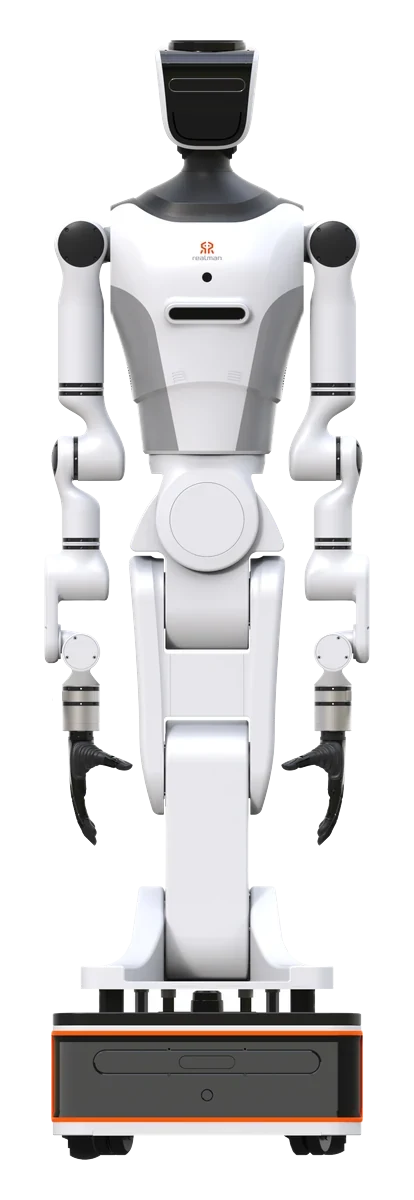 Industrial & logistics robots
RealMan
Humanoid manipulation robot with a detachable wheeled base and 21 degrees of freedom.
 Industrial & logistics robots
RealMan
Full-size wheeled dual-arm humanoid robot with a lift column.
NEXT STEP
Start by defining your work area, task, and integration requirements.