




Advanced Body and Joints
Provides multi-axis mobility and a broad manipulation workspace with a total of 29 degrees of freedom across the head, waist, two legs, and two arms.
HUMANOID ROBOTS · FOURIER
Humanoid platform; a research-focused robot with advanced manipulation and 29 degrees of freedom.
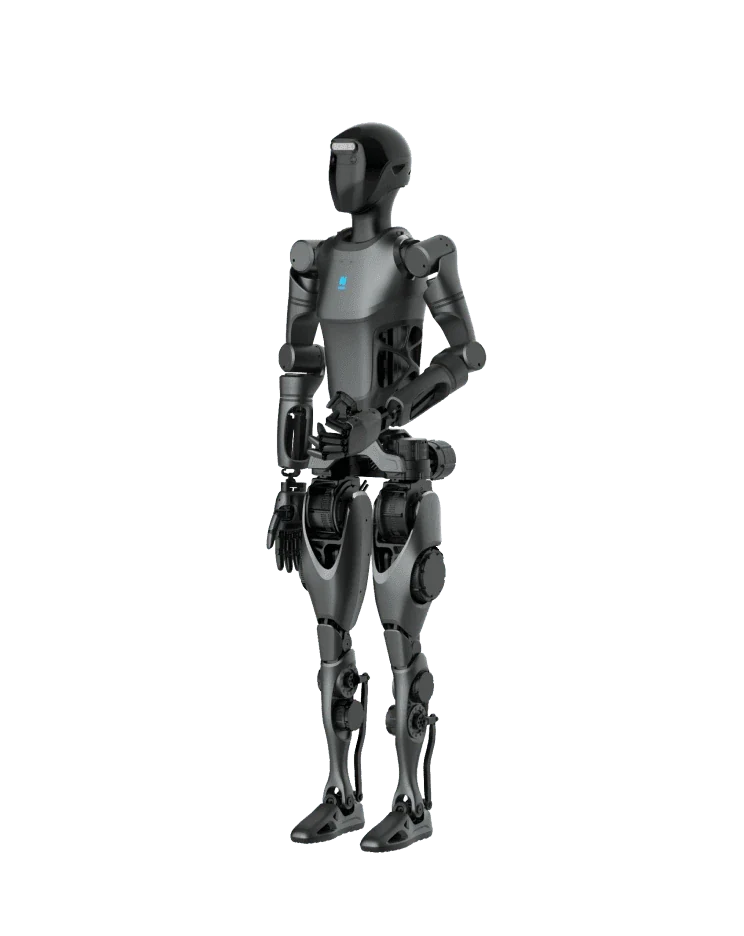
Fourier GR-2 is a second-generation humanoid research and manipulation platform. Its modular actuator design and dexterous-hand configuration combine mobility and perception capabilities.
SELECT BY TASK
Fourier GR-2 is the second-generation platform in the GRx humanoid series. Its 29-degree-of-freedom body architecture and 12-degree-of-freedom dexterous-hand configuration bring the total number of actuators to 53. Designed for carrying and manipulation, the platform offers a foundation suited to research, development, and prototyping, with open software support and rich perception packages. In addition to mechanical capabilities such as walking, arm movements, and end-effector control, its removable battery and modular computing options provide flexibility for field and laboratory use. Fourier Toolkit facilitates integration with ready-made modules supporting ROS, MuJoCo, and NVIDIA-based frameworks.
PRODUCT-SPECIFIC
Features compiled from source product information; evaluate according to the model and configuration.
Provides multi-axis mobility and a broad manipulation workspace with a total of 29 degrees of freedom across the head, waist, two legs, and two arms.
Containing six array-type tactile sensors, the hand detects contact force and adjusts grasping behavior in real time, enabling precise object handling.
Dual-encoder FSA 2.0 actuators improve joint control and torque management, providing driving characteristics suited to the body's dynamics.
Supports both SLAM and pure vision-based perception scenarios with components such as stereo cameras, a 6-axis IMU, and tactile sensors on the fingers.
The removable lithium-ion battery enables quick swaps during field operations and provides flexibility for planned operating periods.
Preconfigured modules that support ROS, MuJoCo, and NVIDIA-based frameworks, together with Fourier Toolkit, enable integration with remote real-time control headsets.
Open hardware interfaces and a modular wiring approach make it suitable for prototyping, algorithm development, and cross-platform experiments.
SOURCED PRODUCT DATA
Values are taken from the source product page. Confirm the package, software, and accessory contents against the manufacturer's current documentation before ordering.
| Feature | Value |
|---|---|
| Dimensions (standing) | 1750 × 552 × 275 mm; arm span 1520 mm, up to 1920 mm with dexterous hands; lower limb 465 mm + 378 mm |
| Weight | 63 kg |
| Arm reach | 1520 mm arm span; up to 1920 mm with the in-house-developed dexterous hands (12 degrees-of-freedom hand version) |
| Arm payload | 3 |
| Maximum speed | 5 |
| Joint torque | 436 N·m (maximum joint peak torque) |
| Joint motion range — source field | Joint position limits (rad, left side): hip pitch -2,618~2,618; hip roll -0,59341~1,5708; hip yaw -0,69813~1,5708; knee pitch -0,087266~2,3562; ankle pitch -0,7854~0,7854; ankle roll -0,38397~0,38397; waist yaw -2,618~2,618; head yaw -1,3963~1,3963; head pitch -0,5236~0,5236; shoulder pitch -2,9671~2,9671; shoulder roll -0,5236~2,7925; shoulder yaw -1,8326~1,8326; elbow pitch -1,5272~0,47997; wrist yaw -1,8326~1,8326; wrist pitch -0,61087~0,61087; wrist roll -0,95993~0,95993 |
| Battery capacity | Approximately 950 Wh |
| Battery | Approximately 950 Wh lithium-ion, removable; rated voltage 39,6 V, charge limit 46,2 V, total weight under 9 kg, service life of more than 500 cycles at 80% depth of discharge; charging time approximately 2 hours |
| Operating time | Approximately 2 hours |
| Charging time | Approximately 2 hours |
| Modes of movement | Full-size bipedal humanoid; torso rotation, grasping, walking, and getting up from the ground |
| Degrees of freedom | 29 body actuators; up to 53 actuators in total with dexterous hands |
| Neck degrees of freedom | 2 DoF |
| Torque density | FSA 2.0 dual-encoder actuator; maximum joint torque 436 N·m; 23 bit / 23 bit dual encoders in the legs, 24 bit / 24 bit in the arms; power output approximately 930 W |
| Material | Aluminum alloy and engineering plastic; integrated wiring that facilitates modularization, with concealed wiring harnesses |
| Manufacturer's note | Safety functions: 1 wireless emergency stop and 1 local emergency stop. |
| Joint configuration | 29 degrees of freedom in the body: head 2, waist 1, legs 6+6, arms 7+7. Basic hands have 6 degrees of freedom; advanced dexterous hands have 12 degrees of freedom; the total number of actuators increases to up to 53 in the dexterous-hand configuration |
| Load capacity | Payload capacity of approximately 3 kg with one arm |
| Battery system | Approximately 950 Wh removable lithium-ion battery; approximately 2 hours of operation, approximately 2 hours to charge |
| Joint module | FSA 2.0 actuator: dual-encoder system, maximum joint torque 436 N·m; 23-bit resolution in the legs, 24-bit in the arms |
| Structure and materials | Aluminum alloy and engineering plastic; concealed wiring harnesses |
| Joint motion range — source field (2) | Waist Z-axis ±150 degrees; knee -5 to 135 degrees; hip pitch ±150 degrees, roll -34 to 90 degrees, yaw -40 to 90 degrees |
| Touch sensing | Second-generation dexterous hand with 12 degrees of freedom; 6 array-type tactile sensors on the fingers measure contact force, distinguish an object's shape and material, and adjust grip in real time |
| Sensors | Stereo camera; supports SLAM and pure vision-based perception and provides an open hardware interface; 6-axis IMU (3-axis accelerometer and 3-axis gyroscope); 6 array-type tactile sensors on the fingers |
| Connectivity | Ethernet communication; Type-C and USB 3.0 I/O |
| Wireless | Wi-Fi 6; wired Ethernet connection |
| Interaction | Voice interaction with echo cancellation; real-time remote control with Pico and Vision Pro headsets |
| Joint encoder | Dual encoders: 23 bit/23 bit (lower limbs), 24 bit/24 bit (upper limbs) |
| Processor | Intel Core i7, 14 cores; optional 275 TOPS computing module |
| Operating system | Ubuntu 20.04 |
| Software features | Fourier Toolkit: A development library of pre-optimized modules that supports the NVIDIA Isaac Lab, ROS, and MuJoCo frameworks |
| Operating temperature | 0 to 45 degrees Celsius; operating humidity of 20 to 80 percent relative humidity, non-condensing |
SEE THE PRODUCT IN ACTION
The introduction video linked from the source product page opens when you press the play button.
PRODUCT INFORMATION SOURCES
This catalog is intended to help explore product information. No commitments are made on behalf of Robotik Çözümler regarding stock, authorized dealers, pricing, warranty, or after-sales service terms.
FREQUENTLY ASKED QUESTIONS
Fourier GR-2 has a body architecture with 29 degrees of freedom (head 2, waist 1, legs 6+6, arms 7+7) and a dexterous hand with 12 degrees of freedom, for a total of 53 actuators. Its dimensions are 1750 × 552 × 275 mm, its weight is approximately 64 kg, and its arm span is 1520 mm, extending to 1920 mm with the dexterous hand. Payload and torque values, along with battery, processor, and software support, are specified in the source information.
The platform supports SLAM and pure vision-based perception scenarios with components such as stereo cameras, a 6-axis IMU, and six array-type tactile sensors in the fingers.
Fourier Toolkit provides preconfigured modules and supports frameworks such as ROS, MuJoCo, and NVIDIA Isaac, adapting to research and simulation workflows.
The device runs on a removable lithium-ion battery; the source states a capacity of approximately 950 Wh, an operating time close to two hours, and a charging time of a similar duration.
IN THE SAME CATEGORY
 Humanoid robots
PUDU
A learning, dual-arm industrial robot for manufacturing and warehouse environments.
 Humanoid robots
 Humanoid robots
Unitree
Awakening Destiny
NEXT STEP
Start by defining your work area, task, and integration requirements.