




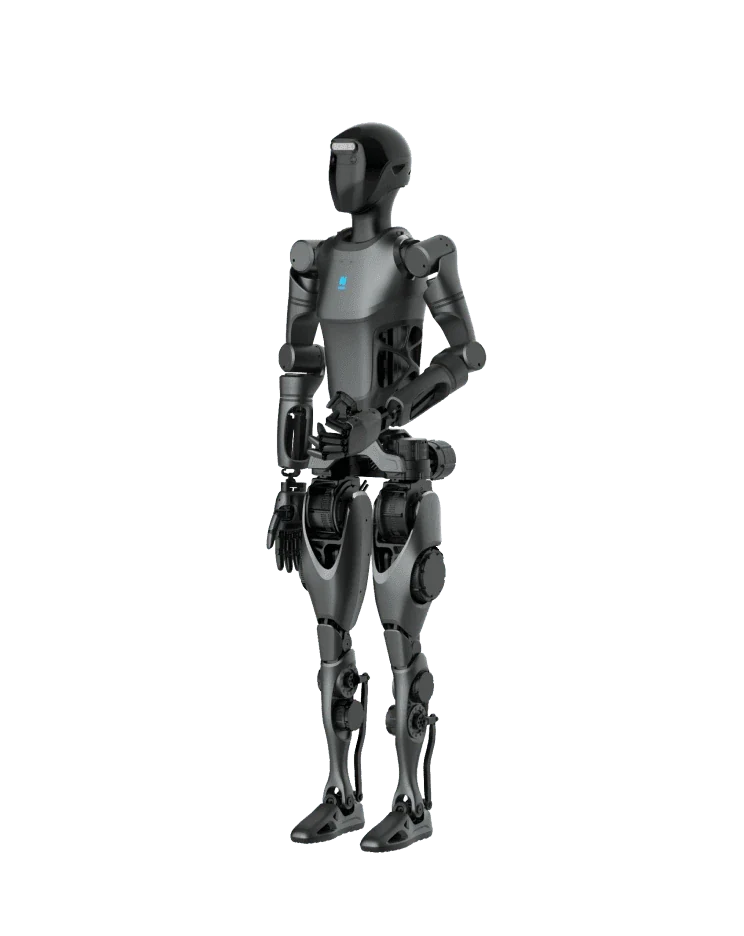
Modular degrees-of-freedom configuration
T1 can be configured with 23, 31, or 41 degrees of freedom to meet different research needs, providing flexibility for walking, balance, and manipulation studies.
HUMANOID ROBOTS · BOOSTER
Development and research-focused humanoid robot platform with modular joint configurations.
Booster T1 is a humanoid robot platform for research and developer use. With modular degrees of freedom, comprehensive software tools, and a sensor package, it is suitable for walking and manipulation research.
SELECT BY TASK
Booster T1 is a laboratory- and research-focused humanoid platform developed by Booster Robotics. Its physical dimensions are 118 × 47 × 23 cm, it weighs approximately 30 kg, and its leg and arm lengths are 57 cm and 45 cm, respectively. The platform is available with 23, 31, or 41 degrees of freedom, depending on the configuration; its motion ranges and torque values are designed for walking and manipulation experiments. Dual encoders on each joint improve accuracy when transferring control policies learned in simulation to the real system. A high-performance onboard module is used as the computing option; the perception package includes a depth camera, 9-axis IMU, and multichannel microphone array. On the software side, comprehensive APIs, open-source tools, a reinforcement learning environment, and developer documentation are provided; these make integration easier for walking control, manipulation, and learning-based work.
PRODUCT-SPECIFIC
Features compiled from source product information; evaluate according to the model and configuration.
T1 can be configured with 23, 31, or 41 degrees of freedom to meet different research needs, providing flexibility for walking, balance, and manipulation studies.
The dual encoders on each joint enable position tracking at both the motor shaft and output shaft, providing reliable data for sim-to-policy transfer and precision control applications.
With a depth camera, 9-axis IMU, and multi-channel microphone array, the robot perception system provides a suitable foundation for localization, environmental perception, and audio-based interaction experiments.
Comprehensive API interfaces, an open-source framework, the Booster Gym reinforcement learning environment, and the Booster SDK accelerate research and development.
High-performance onboard computing modules and x86-based options enable vision and ROS-based stacks to run directly on the platform.
The hardware design and sensor configuration are arranged to support the transfer of simulation-based learning to the real world.
The 10,5 Ah battery configuration targets different runtimes for movement and standby modes; this is taken into account when planning field trials and experiment durations.
Mechanical design principles suited to scenarios involving recovery after falls and operation after impacts in field and competition conditions have been adopted.
SOURCED PRODUCT DATA
Values are taken from the source product page. Confirm the package, software, and accessory contents against the manufacturer's current documentation before ordering.
| Feature | Value |
|---|---|
| Dimensions (standing) | 118 × 47 × 23 cm; leg length 57 cm, arm length 45 cm |
| Weight | 30 kg |
| Arm reach | 45 cm (single arm length) |
| Maximum speed | 1 m/s walking speed; turning speed 1,5 rad/s |
| Joint torque | 130 N·m peak torque |
| Joint motion range — source field | Head: yaw ±58°, pitch -18° to 47°; Shoulder: pitch -188° to 68°, roll -94° to 88°, yaw ±128°; Elbow: -120° to 2°; Waist yaw: ±58°; Hip: pitch ±118°, roll -21° to 88°, yaw ±58°; Knee: 0° to 123°; Ankle: upper joint -23° to 49°, lower joint -24° to 45° (left-side values; right side is mirrored) |
| Battery | 10,5 Ah; 2 hours of operation while walking, 4 hours while standing |
| Operating time | 2 hours walking, 4 hours standing |
| Charging time | ≤2 hours |
| Modes of movement | Bipedal humanoid; walking, running, kicking a ball, push-ups, and martial arts movements |
| Degrees of freedom | 23 (standard) / 31 (gripper) / 41 (dexterous hand) |
| Arm degrees of freedom | 4 (expandable; 7 per arm when a gripper or dexterous hand is installed) |
| Leg degrees of freedom | 6 DoF |
| Waist degrees of freedom | 1 DoF |
| Neck degrees of freedom | 2 DoF |
| End effector | Optional gripper (31 DoF total) or six-degree-of-freedom dexterous hand (41 DoF total) |
| Torque density | Maximum peak torque 130 N·m; dual-encoder joint design |
| Material | Lightweight, durable body; competition model that won the 2025 RoboCup AdultSize category |
| Manufacturer's note | Charging time 2 hours or less; battery cycle life more than 500 cycles; walking noise below 70 dB. Joint ranges of motion: waist +-58 degrees, hip P +-118, R -21 to 88, Y +-58, knee 0 to 123, ankle P -50 to 20 and R +-25 degrees. The manufacturer's documentation declares product certification as CE/FCC. |
| Joint configuration | 23 degrees of freedom in the standard body: 6 per leg, 1 at the waist, 4 per arm (expandable), 2 at the head. With grippers: 31 (7 per arm, 1 per hand); with dexterous hands: 41 (7 per arm, 6 per hand) |
| Joint module | Maximum peak torque 130 N·m; dual encoders at every joint |
| Joint motion range — source field (2) | Waist ±58°; hip pitch ±118°, roll -21° to 88°, yaw ±58°; knee 0° to 123°; ankle pitch -50° to 20°, roll ±25° |
| Battery system | 10,5 Ah battery; 2 hours while walking, 4 hours while standing |
| Structure and materials | 118 × 47 × 23 cm body, approximately 30 kg; leg 57 cm, arm 45 cm |
| Sensors | Depth camera; 9-axis IMU |
| Connectivity | Wi-Fi 6 and Bluetooth 5.2; USB and Ethernet expansion ports |
| Interaction | Circular 6-microphone array and speaker |
| Joint encoder | Dual encoders |
| Processor | NVIDIA AGX Orin, 200 TOPS AI performance; Intel i7 1370p is also included in the Standard and Customized versions |
| Software features | Comprehensive API interfaces, an open-source framework, and open-source tools; secondary development and firmware updates are supported |
| Operating temperature | -10 to 45 °C; operating humidity 5-90 percent, non-condensing |
| Certifications | CE/FCC (manufacturer declaration) |
SEE THE PRODUCT IN ACTION
The introduction video linked from the source product page opens when you press the play button.
PRODUCT INFORMATION SOURCES
This catalog is intended to help explore product information. No commitments are made on behalf of Robotik Çözümler regarding stock, authorized dealers, pricing, warranty, or after-sales service terms.
FREQUENTLY ASKED QUESTIONS
T1’s body dimensions are listed as 118 × 47 × 23 cm, with a weight of approximately 30 kg; its leg length is 57 cm and arm length is 45 cm.
There are three main configurations: Basic with 23 degrees of freedom (6 per leg, 1 at the waist, 4 per arm, and 2 at the head), Standard with a gripper and 31 degrees of freedom, and the Customized version, which offers a total of 41 degrees of freedom with a dexterous hand with six degrees of freedom. The choice depends on research goals.
Example ranges of motion include waist ±58°, hip pitch ±118°, knee 0–123°, and ankle pitch from -50° to 20°. On the drive side, the stated maximum peak torque and dual encoders on each joint are intended for precise control and feedback.
The platform is offered to support research and software development with comprehensive APIs, open-source tools, the Booster Gym reinforcement learning environment, Booster SDK, and developer documentation.
T1 includes a depth camera, a 9-axis IMU, and a multichannel microphone array for perception; Wi‑Fi 6 and Bluetooth 5.2 are available for networking, along with USB and Ethernet interfaces for expansion.
IN THE SAME CATEGORY
 Humanoid robots
PUDU
A learning, dual-arm industrial robot for manufacturing and warehouse environments.
 Humanoid robots
 Humanoid robots
Unitree
Awakening Destiny
NEXT STEP
Start by defining your work area, task, and integration requirements.