




Advanced Visual Perception
An OAK camera with stereo depth enables facial recognition and dynamic tracking, keeping the user within the robot's expressive field for natural interaction.
HUMANOID ROBOTS · FOURIER
A 165 cm-tall, interaction-focused third-generation humanoid robot.
Fourier GR-3 is a third-generation humanoid robot distinguished by its interaction and perception capabilities. Combining walking, facial and voice recognition, and tactile perception, it is designed for use in social and well-being support applications.
SELECT BY TASK
The Fourier GR-3 series is a third-generation humanoid robot focused on perception and multimodal emotion processing in human-robot interaction. Designed to be 165 cm tall and weigh 71 kg, GR-3 offers rich perception capabilities with components such as an OAK camera with stereo depth, multichannel audio perception, pressure sensors distributed across the body, and 55 degrees of freedom for movement. A facial-expression display and real-time gaze tracking combine with tactile feedback to enable natural behavior in social interaction and well-being applications. The series is available in three configurations: GR-3 with full interaction hardware, GR-3C with a simplified exterior, and GR-3C Ultra with optional LiDAR.
PRODUCT-SPECIFIC
Features compiled from source product information; evaluate according to the model and configuration.
An OAK camera with stereo depth enables facial recognition and dynamic tracking, keeping the user within the robot's expressive field for natural interaction.
A four-microphone array enables omnidirectional voice activation, echo suppression, and sound-source localization; the robot turns toward the speaker and makes eye contact in real time.
A total of 31 pressure sensors—16 in the head and 15 in the body—detect touch in real time and respond with micro-expressions.
A real-time emotion-processing engine combines visual, auditory, and tactile channels to coordinate multimodal interaction and produce natural responses.
With a total of 55 degrees of freedom, simultaneous control of head, waist, arm, and leg movements, and a 3 kg single-arm payload capacity provide flexibility suited to interactive tasks.
The supporting structure is made of aluminum alloy and engineering plastic; the outer surface uses Alcantara and foam padding to provide both durability and a pleasant tactile experience for the user.
Data from the 6-axis IMU and foot contact sensors is used to dynamically adjust the leg joints and optimize walking behavior on flat and uneven terrain.
The product line accommodates different usage requirements with three configurations: the fully interactive GR-3, the streamlined, easy-to-maintain GR-3C, and the GR-3C Ultra with optional LiDAR.
SOURCED PRODUCT DATA
Values are taken from the source product page. Confirm the package, software, and accessory contents against the manufacturer's current documentation before ordering.
| Feature | Value |
|---|---|
| Dimensions (standing) | 165 cm tall |
| Weight | 71 kg |
| Arm reach | 1395 mm arm span; up to 1759 mm with their own agile hand (12-degree-of-freedom hand version) |
| Arm payload | 3 |
| Maximum speed | 5.5 |
| Climbing angle | 15 degrees (maximum walking slope) |
| Joint torque | 440 N·m (maximum joint peak torque) |
| Joint range of motion | Neck pitch -30°~8,5°; neck yaw ±80°; shoulder pitch ±170°; shoulder roll -15°~110°; shoulder yaw ±105°; elbow pitch -130°~5°; wrist yaw ±105°; wrist pitch -50°~75°; wrist roll -60°~70°; waist pitch -12°~30°; waist roll ±10°; waist yaw ±150°; hip pitch ±150°; hip roll -10°~90°; hip yaw -40°~90°; knee pitch 0°~135°; ankle pitch ±45°; ankle roll ±25° (left-side joint values) |
| Battery capacity | 702 Wh + 234 Wh |
| Battery | Lithium-ion, 702 Wh + 234 Wh; total weight 3,8 kg + 1,3 kg; rated voltage 46,8 V, charging limit voltage 54,6 V; cycle life 500 or more (80 percent DOD); supports hot swapping; approximately 1,5 hours to fully charge once |
| Operating time | 3 hours |
| Charging time | Approximately 1,5 hours (single charge) |
| Charger | Adapter input 90 V AC ~ 260 V AC, 50 Hz / 60 Hz; adapter output 54,6 V, 12 A MAX |
| Operating power | Rated power approximately 936 W |
| Operating voltage | Rated voltage 46,8 V; adapter input 90-260 V AC, 50/60 Hz; adapter output 54,6 V, maximum 12 A |
| Modes of movement | Full-size bipedal humanoid; terrain walking and balance recovery |
| Degrees of freedom | 55 DoF |
| Neck degrees of freedom | 2 DoF |
| End effector | Standard dexterous hand with 6 degrees of freedom; optional dexterous hand with 12 degrees of freedom (arm span up to 1.759 mm with dexterous hand) |
| Torque density | 3 kg payload with one arm; head 2, waist 3, arms 7 and legs 6 degrees of freedom, standard dexterous hand 6 degrees of freedom, optional dexterous hand 12 degrees of freedom |
| Material | Alcantara surface, foam padding, supporting structure made of aluminum alloy and engineering plastic; skin-like touch reminiscent of a sports car interior |
| Joint configuration | Total of 55 degrees of freedom; head 2, waist 3, arms 7, legs 6, standard dexterous hand 6, optional dexterous hand 12 |
| Load capacity | 3 kg carrying capacity with one arm |
| Battery system | 3 hours of operating time |
| Structure and materials | Alcantara surface, foam padding, supporting structure made of aluminum alloy and engineering plastic |
| Touch sensing | 31 pressure sensors: 16 in the head, 15 in the body; real-time touch detection; a touch sensor can be added to the hand with the 12-degree-of-freedom dexterous hand |
| Sensors | Stereo depth OAK camera module; 6-axis IMU (acceleration and angular velocity); 31 pressure sensors distributed throughout the body (16 in the head, 15 in the body); optional Robosense Airy LiDAR on the GR-3C Ultra version |
| Connectivity | Wired Ethernet and Wi-Fi 6; Type-C, USB 3.0 and RJ45 input/output |
| Wireless | Wi-Fi 6; wired Ethernet connection |
| Interaction | Four-microphone array: omnidirectional voice wake-up, echo suppression and precise sound-source positioning; 15 W speaker (5 W in the Ultra version); LED screen displaying facial expressions; the robot turns to face the speaker while maintaining eye contact |
| Joint encoder | Dual encoders: supports absolute encoders |
| Processor | AMD Ryzen 7 8845HS, 8 cores, 16 threads; D70 development board, AMD Radeon 780M graphics, 16 MB L3 cache, 32 GB memory, 1 TB storage |
| Operating system | Ubuntu 22.04 |
| Software features | The Multimodal Interaction System combines vision, sound, and touch in a single real-time emotion-processing engine; voice interaction powered by a large language model; animated micro-expressions respond to touch with social cues; real-time remote control is optional |
| Operating temperature | 0 to 45 degrees Celsius; operating humidity 20 to 80 percent, non-condensing |
SEE THE PRODUCT IN ACTION
The introduction video linked from the source product page opens when you press the play button.
PRODUCT INFORMATION SOURCES
This catalog is intended to help explore product information. No commitments are made on behalf of Robotik Çözümler regarding stock, authorized dealers, pricing, warranty, or after-sales service terms.
FREQUENTLY ASKED QUESTIONS
GR-3 comes equipped with a height of 165 cm, a weight of 71 kg, 55 degrees of freedom, a single-arm payload capacity of 3 kg, a walking speed of 5,5 km/s, and an operating time of approximately 3 hours. Its perception layer includes an OAK camera with stereo depth, a 6-axis IMU, and 31 pressure sensors distributed across the body.
The mechanical base remains the same; GR-3 comes with full interaction hardware, while GR-3C offers a simplified shell by removing the interaction layers. GR-3C Ultra differs by adding optional LiDAR and some speaker enhancements. All three have an OAK camera, IMU, and facial expression display.
The model includes a total of 31 pressure sensors—16 in the head and 15 in the body—a four-microphone array, and an OAK camera with stereo depth; these sensors are combined by an engine that processes visual, auditory, and tactile data in real time.
GR-3 is a platform focused on well-being and social interaction; with a single-arm capacity of 3 kg, heavy lifting, transfers, and intensive physical care tasks are outside its scope.
IN THE SAME CATEGORY
 Humanoid robots
PUDU
A learning, dual-arm industrial robot for manufacturing and warehouse environments.
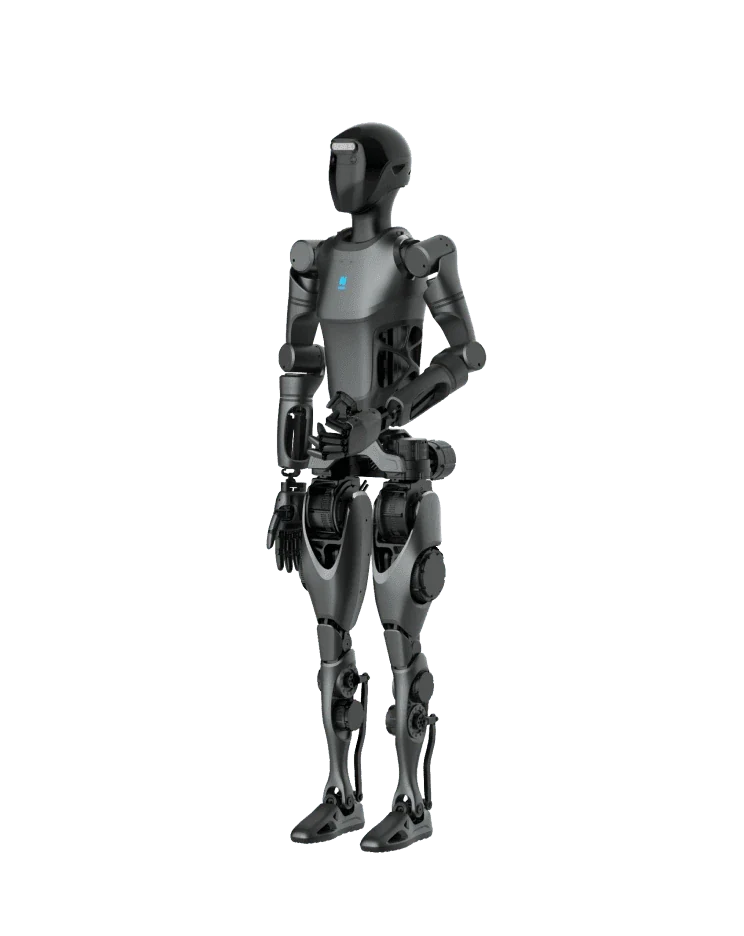 Humanoid robots
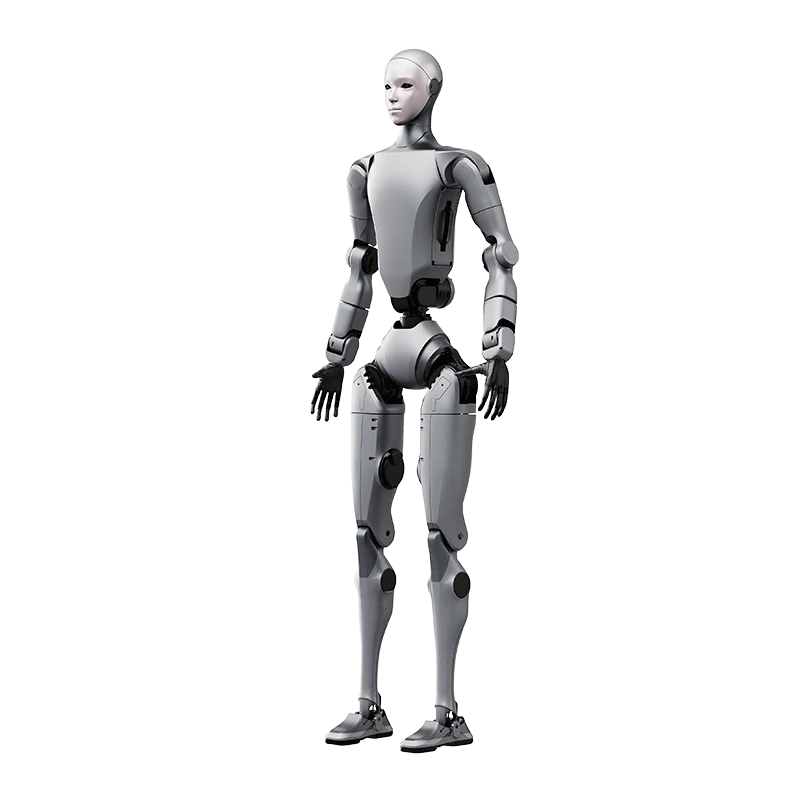 Humanoid robots
Unitree
Awakening Destiny
NEXT STEP
Start by defining your work area, task, and integration requirements.