




Dynamic motion capabilities
N1 is designed to perform dynamic movements such as moving on sloped surfaces and stair steps, balancing on one leg, and push-ups from the ground; these mobility capabilities can be used in research trials.
HUMANOID ROBOTS · FOURIER
Open-source humanoid robot; a platform for embodied intelligence research.
Fourier N1 is an open-source humanoid research platform. With multimodal motion and hardware resource packages, it is suitable for embodied intelligence and motion research.
SELECT BY TASK
Fourier N1 is an open-source humanoid robot platform designed for embodied intelligence and humanoid motion research. Its multimodal motion control, modular hardware components, and published resource packages support researchers through design, replication, and software development. Published values in the product materials and brochure cover technical information such as dimensions, weight, degrees of freedom, joint performance, battery, and computing platform. With capabilities including dynamic walking, running, and one-legged balance, N1 provides an experimental platform for laboratory and field research.
PRODUCT-SPECIFIC
Features compiled from source product information; evaluate according to the model and configuration.
N1 is designed to perform dynamic movements such as moving on sloped surfaces and stair steps, balancing on one leg, and push-ups from the ground; these mobility capabilities can be used in research trials.
A complete hardware resource package has been published; design drawings, a bill of materials, an assembly guide, and basic operating software facilitate research and replication.
Published technical data is available on topics including mechanics, joints, electronics, batteries, and computing; this information serves as a reference for platform integration and evaluation.
The frame is made of lightweight aluminum alloy and engineering plastics; its compact design makes it easy to transport and assemble in laboratory and mobile-use scenarios.
Perception and navigation experiments can be conducted on the platform using sensing components such as an optional binocular depth camera and a 6-axis IMU.
Joint-level performance parameters and Ethernet-based communication make it suitable for research applications requiring precise control and data streaming.
Published licenses are available for URDF models, SDK documentation, and deployment/training frameworks; these licenses should be assessed in line with project requirements.
Published battery specifications, operating times, and charge cycle data provide a reference for laboratory planning and field trials.
SOURCED PRODUCT DATA
Values are taken from the source product page. Confirm the package, software, and accessory contents against the manufacturer's current documentation before ordering.
| Feature | Value |
|---|---|
| Dimensions (standing) | 130 cm tall (product page); brochure lists 1245 × 441 × 202 mm, 1240 mm arm span |
| Weight | 38 kg |
| Arm reach | 1240 mm arm span |
| Maximum speed | 3,5 m/s |
| Climbing angle | 15-20 degree incline |
| Obstacle and step | 20 cm stair step |
| Joint torque | 144 N·m (peak joint torque) |
| Joint range of motion | Joint position limits (rad, left side): hip pitch -2,617~2,617; hip roll -0,261~1,57; hip yaw -2,617~2,617; knee pitch -0,0872~2,356; ankle roll -0,436~0,436; ankle pitch -0,436~0,436; waist yaw -2,617~2,617; shoulder pitch -2,966~2,966; shoulder roll -0,174~2,792; shoulder yaw -1,832~1,832; elbow pitch -0,349~1,658; wrist yaw -1,832~1,832 |
| Battery capacity | 475 Wh |
| Battery | 475 Wh lithium-ion, under 3,2 kg; nominal voltage 39,6 V, cutoff voltage 46,2 V, lifespan over 800 cycles (25 degrees, 10 A discharge, SOH %80); charging time approximately 3,5 hours |
| Operating time | 2 hours |
| Charging time | Approximately 3,5 hours |
| Charger | Adapter input 100-240 V 50/60 Hz; adapter output 46 V 4 A |
| Operating power | Rated power approximately 460 W |
| Operating voltage | Nominal voltage 39,6 V; joint operating voltage 24-60 V, nominal 46 V; adapter input 100-240 V 50/60 Hz, adapter output 46 V 4 A |
| Modes of movement | Bipedal humanoid; brisk walking, running, stair climbing, single-leg balance, and push-ups from the floor; 15-20 degree incline and 20 cm stair step |
| Degrees of freedom | 23 DoF |
| Neck degrees of freedom | 0 DoF |
| Torque density | Maximum peak joint torque 144 N·m; peak current 70 A, operating voltage 24-60 V, rated voltage 46 V, backlash under 10 arcmin, dual encoder 16 bit / 14 bit; rated power approximately 460 W |
| Material | Lightweight aluminum alloy and engineering plastic frame; simple, durable, and stable hardware design |
| Joint configuration | 23 actuators in total: legs 6+6, waist 1, arms 5+5; no head joint |
| Battery system | 475 Wh lithium-ion battery, under 3,2 kg; over 2 hours of continuous operation, approximately 3,5 hours to charge, lifespan over 800 cycles |
| Joint module | Peak torque 144 N·m, peak current 70 A, operating voltage 24-60 V, backlash under 10 arcmin, dual encoders at 16 bit and 14 bit, Ethernet communication |
| Structure and materials | Lightweight aluminum alloy and engineering plastic |
| Sensors | Optional binocular depth camera; 6-axis IMU (acceleration and angular velocity) |
| Connectivity | MT7921K module, Wi-Fi 6; 100M, 1000M, and 2500M LAN; HDMI, USB Type-C, and Type-A input/output; Ethernet joint communication |
| Wireless | Wi-Fi 6; wired network 100M / 1000M / 2500M |
| Interaction | Remote control with a Bluetooth game controller |
| Joint encoder | Dual encoders: 16 bit/14 bit |
| Processor | Intel Core i7-13700H, Intel Iris Xe graphics, 16 GB memory, 512 GB NVMe storage |
| Operating system | Ubuntu 20.04 |
| Software features | A complete hardware source package has been published: design drawings, bill of materials, assembly guide, and basic operating software. URDF models are published under the Apache-2.0 license, SDK documentation under the MIT license, and deployment and training repositories under the LGPL-3.0 license |
SEE THE PRODUCT IN ACTION
The introduction video linked from the source product page opens when you press the play button.
PRODUCT INFORMATION SOURCES
This catalog is intended to help explore product information. No commitments are made on behalf of Robotik Çözümler regarding stock, authorized dealers, pricing, warranty, or after-sales service terms.
FREQUENTLY ASKED QUESTIONS
Parameters such as peak joint torque, peak current, gear backlash, and encoder resolutions have been published in the source; these can be used in joint control and motion performance evaluations.
According to published data, the battery is specified as 475 Wh lithium-ion, with a continuous operating time of over 2 hours, a charging time of approximately 3,5 hours, and a battery life of more than 800 cycles.
The source states that it features Intel Core i7-13700H-based computing, 16 GB of memory, 512 GB NVMe storage, and Ubuntu 20.04, along with network modules supporting Ethernet and Wi‑Fi 6.
According to published information, URDF simulation models are provided under Apache‑2.0, SDK documentation under MIT, and deployment/reinforcement learning frameworks under LGPL‑3.0 licenses; license compatibility should be reviewed according to project requirements.
According to information published in the source, the platform is designed to support a range of dynamic movements, including inclines, stair steps, single-leg balance, and push-ups from the ground.
IN THE SAME CATEGORY
 Humanoid robots
PUDU
A learning, dual-arm industrial robot for manufacturing and warehouse environments.
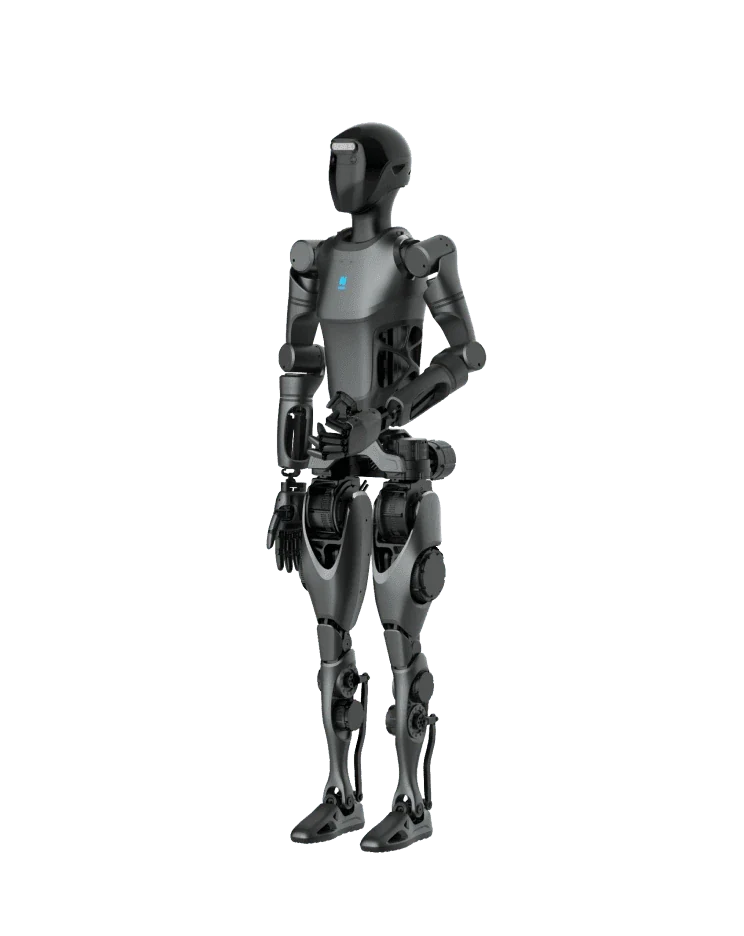 Humanoid robots
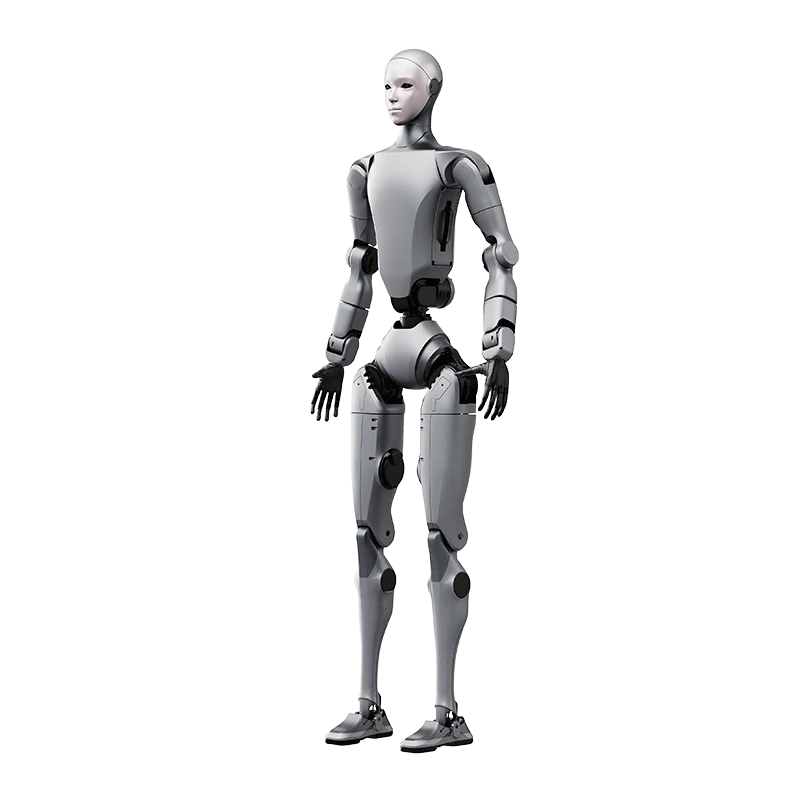 Humanoid robots
Unitree
Awakening Destiny
NEXT STEP
Start by defining your work area, task, and integration requirements.